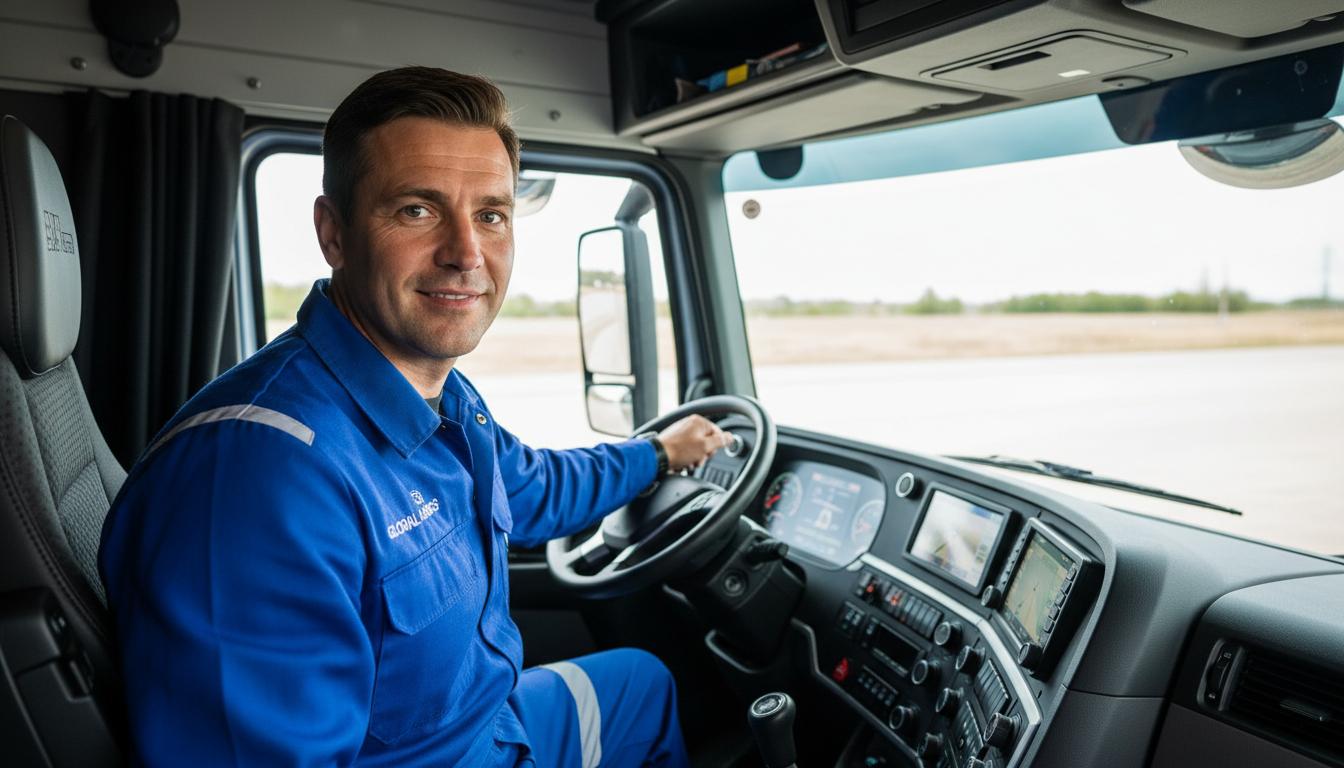
CDL classes
| Class | Vehicles |
|---|---|
| Class A | Combinations of 26,001 pounds or more GCWR where the towed unit is over 10,000 pounds (most tractor-trailers) |
| Class B | Single vehicles of 26,001 pounds or more GVWR, or one towing 10,000 pounds or less (straight trucks, dump trucks) |
| Class C | Smaller vehicles carrying 16 or more people including the driver, or placarded hazardous materials |
Endorsements are added for special vehicles or loads, such as H (hazmat), N (tank), T (doubles and triples), P (passenger) and S (school bus).
Getting a CDL
- 1Get a DOT medical examination from an examiner on the National Registry.
- 2Pass the knowledge test and get a commercial learner's permit (CLP). You must be at least 18, and the CLP is valid for up to one year.
- 3Complete entry-level driver training (ELDT) with a provider listed on FMCSA's Training Provider Registry. It is required for a first Class A or B CDL, an upgrade from B to A, and a first H, P or S endorsement.
- 4Wait at least 14 days after your CLP was issued, then take the skills test.
Up next
Rules every interstate driver must meet
3 of 5 sections
Rules every interstate driver must meet
- Age 21 or older for interstate driving. States set the intrastate minimum, often 18. The federal under-21 apprenticeship pilot ended in November 2025.
- A valid DOT medical certification, for up to 24 months. For CDL and CLP holders the examiner now sends results to the state electronically, and the state driving record is the proof.
- English proficiency: able to read and speak English well enough to talk with the public, understand road signs and respond to officers. Since June 2025 a violation puts the driver out of service.
- No disqualifying violations, and a Clearinghouse record that allows safety-sensitive work.
Before your first driver's first trip
- 1Get a complete employment application with three years of license history and prior employers.
- 2Order motor vehicle records from every state where the driver held a license in the past three years.
- 3Run a full pre-employment Clearinghouse query with the driver's consent.
- 4Get a negative pre-employment DOT drug test result.
- 5Request drug and alcohol testing history from previous DOT employers.
- 6Confirm the medical certification and do a road test (or accept a valid CDL in place of it).
- 7Put everything in the driver qualification file and add the driver to your random testing pool.
Owner-operators who are their only driver must still join a random testing pool, usually through a consortium.
Recent changes to know about
- Since March 16, 2026, non-domiciled CDLs and CLPs can only be issued to foreign applicants with certain employment-based visa status.
- Since July 22, 2026, CDL holders no longer have to self-report violations to their home state under the federal rule.
- FMCSA has proposed dropping the 14-day wait between the CLP and the skills test; it is not final.